How to Manage Test Anxiety Before the AFPSAT
By GMBOY · Published 10/15/2026 · Updated 10/15/2026 · 7 min read
How to Manage Test Anxiety Before the AFPSAT
Feeling nervous before the AFPSAT is normal. Many examinees are taking their first timed aptitude test, sometimes far from home, with a career plan riding on one morning. A little pressure can keep you alert. The goal of this guide is not to make the nerves disappear. It is to keep them from costing you points.
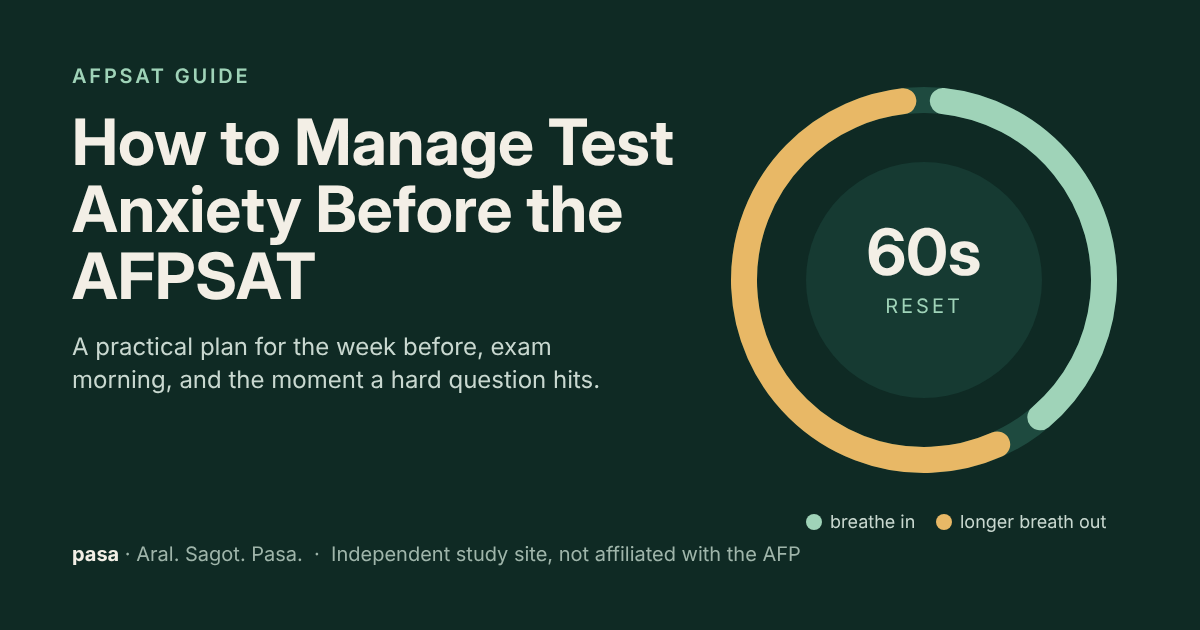
You will find a 7-day lead-up plan, an exam-morning routine, a 60-second reset you can use in the testing room, and pacing advice for each section of the format Pasa models.
Note: This guide offers study and pacing ideas for AFPSAT learners. It is not medical advice and it does not promise to remove anxiety. If worry is affecting your sleep, appetite, or daily life for weeks at a time, talk to a qualified health professional or someone you trust.
Why the AFPSAT feels stressful
Knowing what triggers the pressure makes it easier to plan for. For most learners it comes from three places:
The clock. The test is divided into timed sections, and one of them moves very fast. Watching time run out is the single most common trigger.
Uncertainty. First-timers often don't know what the room, the answer sheet, or the instructions will look like.
The stakes. The AFPSAT is an early step in a longer screening process, so it can feel like everything depends on it. It helps to remember that it is one step, and that the later stages are separate. Our guide on the screening stages after the AFPSAT explains what comes next.
Each of these has a practical answer: practise with the clock, remove the unknowns, and keep the test in proportion.
Know your pace for each section
Much of exam-day panic comes from not knowing whether you are "behind." If you know your target pace before you walk in, a quick glance at the clock tells you where you stand.
Section (format Pasa models)ItemsTimeAverage time per itemVerbal Reasoning6535 minabout 32 secondsNumerical Reasoning3535 minabout 60 secondsAbstract Reasoning5012 minabout 14 seconds
Always follow the instructions given by your examiners on test day. The table above reflects the practice format used on Pasa, not an official AFP document.
What this means for nerves:
Verbal Reasoning: At about half a minute per item, you cannot reread long passages several times. Read the question first, then look for the evidence in the passage. Our Verbal Reasoning guide walks through this method.
Numerical Reasoning: You have the most time per item here, which can tempt you to fight one problem for three minutes. Set a personal limit, roughly 90 seconds, then make your best choice and move on. See how to solve faster without a calculator.
Abstract Reasoning: This section moves the fastest. Expect it to feel rushed, and don't treat that feeling as a sign you are failing. Check one rule at a time (shape, count, rotation, shading) instead of staring at the whole figure. Our Abstract Reasoning pattern guide lists the common pattern types.
The 7-day lead-up plan
Cramming the night before raises anxiety and rarely raises scores. Use the final week to build familiarity instead.
DayFocusWhat to do7 days beforeBaselineTake one full timed mock exam. Note which section felt the most rushed.6 days beforeWeakest sectionPractise 20 questions from that section and read every explanation, including the ones you got right.5 days beforeSecond-weakest sectionSame approach: short sets, careful review.4 days beforePacing drillDo short timed sets at the target pace in the table above.3 days beforeLogisticsConfirm the venue, travel time, and what you are told to bring. Read our exam day guide.2 days beforeSecond mockTake another timed mock. Compare your pacing, not just your score.1 day beforeLight reviewReview your saved mistakes for 30–45 minutes, then stop. Prepare your things and rest.
You can take a free timed run on the Pasa mock exam and practise by section on the AFPSAT practice page.
The night before and exam morning
The night before:
Pack your bag: the documents and materials your examiners asked for, a pencil and eraser if allowed, water, and a simple snack for after.
Lay out your clothes.
Plan your route and leave extra time for traffic or weather.
Stop studying at a set time. One more hour of review is rarely worth a worse night's sleep.
Exam morning:
Eat a familiar breakfast. Exam day is not the time to try a new food or drink.
Arrive early enough that you are not rushing, but not so early that you spend an hour comparing notes with nervous strangers.
While you wait, skip last-minute cramming. Instead, quietly go over your pacing targets: 32 seconds, 60 seconds, 14 seconds.
The 60-second reset
Even well-prepared examinees hit a moment where their mind goes blank. When that happens, use this short routine instead of pushing through the panic.
Pen down (0–10 seconds). Stop reading. Put the pencil down and sit back with your feet flat on the floor.
Slow breaths (10–30 seconds). Take two slow breaths, making each breath out a little longer than the breath in, for example in for 3, out for 5.
Name the next step (30–45 seconds). Choose one small action: "Read the question stem again" or "Eliminate one choice."
Check the clock (45–60 seconds). Look at the time once. Mark your best answer, and move on.
A full minute is a lot in Abstract Reasoning, so in that section shorten it to one slow breath and step 3. Practise the reset during your mock exams so it feels automatic on the day.
What to do after a hard question
A difficult item often causes more damage after you leave it, because you keep thinking about it while answering the next five. Try this:
Decide, then let go. Choose the best remaining option. A blank answer guarantees no point; a reasoned guess at least gives you a chance. Follow your examiners' instructions on how answers are marked.
Use elimination. Removing even one clearly wrong choice improves your odds.
Reset your attention. Tell yourself, "That item is finished." The next question is worth the same as the one you just left.
Don't judge the whole test by one section. Many examinees feel worst after Abstract Reasoning simply because it is fast. That feeling says little about your actual result.
Practise under pressure, carefully
Timed practice is the most reliable way to make the real test feel familiar. Use it wisely:
Start untimed, then add the clock. Learn the question types first, then practise at the target pace.
Review more than you test. Ten questions with careful review beat fifty questions rushed with no review.
Track patterns, not just scores. Note whether your mistakes come from rushing, misreading, or not knowing the concept. Each one needs a different fix.
Rehearse the reset. Use the 60-second reset at least once during each mock so it is ready when you need it.
When to seek extra support
Some nervousness is expected before any important test. Consider talking to someone if worry about the exam:
keeps you from sleeping or eating normally for days at a time,
stops you from studying at all, or
feels overwhelming or out of proportion to the situation.
A trusted family member, mentor, guidance counselor, or qualified health professional can help. Asking for support is part of preparing well.
Frequently asked questions
Is it normal to feel nervous before the AFPSAT? Yes. Most examinees feel some pressure. The aim is to manage it so it doesn't affect your pacing or decisions.
What should I do if my mind goes blank during the test? Use the 60-second reset: pen down, two slow breaths, name one small next step, check the clock, and move on.
Should I study the night before the AFPSAT? A short, light review of your saved mistakes is fine. Long cramming sessions usually raise anxiety and cut into sleep.
Which AFPSAT section is the most stressful? For many learners it is Abstract Reasoning, because the time per item is very short. Knowing that in advance helps you stay calm when it feels fast.
Does Pasa offer official AFPSAT questions? No. Pasa's practice questions and mock exams are original study material and do not reproduce an official AFPSAT examination.
Pasa is an independent study site and is not affiliated with, endorsed by, or operated by the Armed Forces of the Philippines. For official requirements and schedules, check the official AFP and service-branch recruitment channels.