AFPSAT Numerical Reasoning: How to Solve Faster Without a Calculator
By GMBOY · Published 7/16/2026 · 5 min read
AFPSAT Numerical Reasoning: What to Expect and How to Solve Faster Without a Calculator
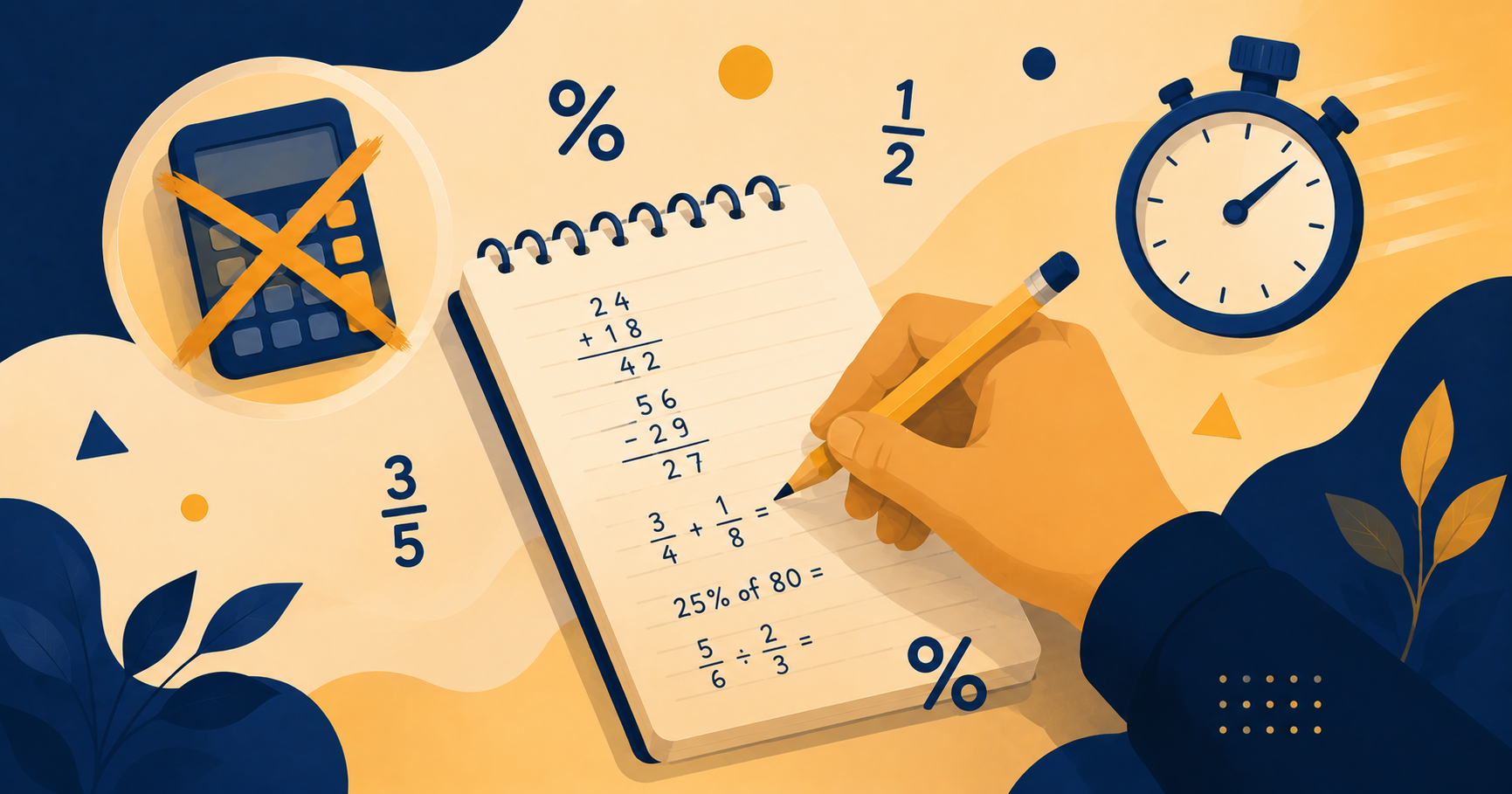
Here's the sentence that changes how you should prepare for the AFPSAT's numerical section: calculators are not allowed. Every computation — every percentage, every division, every multi-step word problem — happens with your pencil and your head, inside a section running on its own strict timer. The math itself is high school level; the challenge is doing it quickly and accurately by hand, possibly years after you last did arithmetic on paper.
This guide covers what the section tests, the manual-math skills that matter most, and how to train speed without sacrificing accuracy.
What the numerical section covers
The AFPSAT's Numerical Reasoning section is one of its three separately timed parts (alongside Verbal and Abstract/Logical Reasoning) within the 150-item exam. Expect questions drawn from:
Basic operations — addition, subtraction, multiplication, and division of whole numbers, fractions, and decimals, sometimes in multi-step chains.
Percentages, ratios, and proportions — finding percentages of amounts, percent increase and decrease, and dividing quantities in a given ratio.
Word problems — practical scenarios involving money, rates, distances, work, ages, and quantities, where the first task is translating the story into arithmetic.
Number sequences — identifying the pattern in a series and supplying the next term.
Nothing requires trigonometry, calculus, or advanced algebra. If you can comfortably handle Grade 7–10 math by hand, you can handle this section — the preparation is about restoring speed, not learning new theory.
Rebuild your manual-math foundation first
Because everything is by hand, the highest-return preparation is unglamorous: relearn to compute on paper, fast.
Multiplication tables to 12, cold. Hesitating on 7×8 costs a second every time it appears, and it appears constantly inside bigger problems. Drill until recall is instant.
Long division and multi-digit multiplication. Do a page of each until the mechanics are automatic again. Most examinees haven't done long division since grade school, and the exam room is a bad place to rediscover it.
Fraction–decimal–percent conversions from memory. 1/4 = 25%, 1/5 = 20%, 1/8 = 12.5%, 3/4 = 75%, 1/3 ≈ 33.3%. Converting instantly between forms lets you pick whichever form makes a given problem easiest — "75% of 240" is painful as 0.75 × 240 but trivial as 3/4 × 240 = 180.
Speed techniques that work without a calculator
Break percentages into 10% and 1% blocks. To find 23% of 400: 10% is 40, so 20% is 80; 1% is 4, so 3% is 12; total 92. This mental method is faster than pencil multiplication for most percentage items and easy to double-check.
Estimate before computing, and let the choices do the work. The AFPSAT is multiple choice, and options are often spread far apart. Round 198 × 21 to 200 × 20 = 4,000; if only one choice is near 4,000, you're done without exact multiplication. Always glance at the spread of the answer choices before deciding how precisely you need to compute.
Work backwards from the options. For problems like "A number increased by 15% becomes 92. What was the number?", testing the middle answer choice (80 × 1.15 = 92 ✓) is often faster than setting up the algebra. Start from a middle value so one test tells you whether to go higher or lower.
Simplify ratios with the "parts" method. "Divide ₱1,200 between two people in the ratio 2:3" — add the parts (5), divide (₱240 per part), multiply back (₱480 and ₱720). One reusable move covers ratio sharing, mixtures, and scaling problems.
Cancel before you multiply fractions. For (3/8) × (4/9), cancel first: 3 with 9, 4 with 8, leaving (1/2) × (1/3) = 1/6. Cancelling early keeps numbers small, and small numbers mean fewer arithmetic slips.
The traps to watch for
The wrong answer choices on numerical items aren't random — they're the results of predictable mistakes. Watch for unit mismatches (the problem gives minutes, the question asks hours), "each" versus "total" (you computed the total; the choice showing the per-person amount is sitting right there), percent of the wrong base (a 20% discount then 10% off the discounted price is not 30% off), and sequence direction errors (a series decreasing by growing gaps punishes assuming a constant difference). When your computed answer matches a choice, take three seconds to confirm it answers the actual question asked — that habit alone recovers several points per exam.
Pacing inside a separately timed section
Because each AFPSAT section closes when its own timer ends, pacing is local: time saved here can't rescue another section, and time lost here can't be repaid. Practical rules: move through in one steady pass, giving each item up to about a minute; mark anything stubborn and return to it within the section; use estimation aggressively on items with widely spread choices; and as the timer winds down, fill every blank with your best elimination-based guess. A blank is a guaranteed zero; a guess after eliminating one or two options is meaningfully better than chance.
A three-week training plan
Week 1 — mechanics. Daily: ten minutes of times-table and mental-math drills, one page of by-hand computation (long division, multi-digit multiplication, fraction operations), and the conversion table until it's memory. Week 2 — problem types. One topic per day — percentages, ratios, sequences, then word problems for the rest of the week, since translation is the skill most people lack. Untimed, focused on method. Week 3 — exam conditions. Mixed randomized sets at roughly a minute per item, reviewing every explanation, plus at least one full sectioned mock so the separately timed format is familiar. Pasa's AFPSAT Numerical Reasoning quizzes and the full AFPSAT mock exam follow exactly this structure — randomized items, explanations, and a per-section timer — and they're free with no login.
The bottom line
AFPSAT numerical reasoning rewards the examinee who shows up with restored pencil-and-paper fluency, a small kit of speed techniques, and disciplined pacing. None of that is talent — all of it is training. Three weeks of daily manual math turns the no-calculator rule from your biggest fear into your quiet advantage over every applicant who assumed they'd wing it.
The AFPSAT's format and item styles can vary by test version and are periodically updated. Always follow official instructions on exam day. Pasa is an independent study aid, not affiliated with the AFP.