How to Beat Test Anxiety on the CSE & AFPSAT
By GMBOY · Published 7/13/2026 · Updated 7/13/2026 · 5 min read
How to Beat Test Anxiety on Any Government Exam
Nervous about the CSE or AFPSAT? You're in good company. Walk into any testing center on exam day and you'll see hundreds of people gripping their pencils a little too hard. A certain amount of nerves is normal — and even useful, because mild stress sharpens focus. The problem is when anxiety crosses the line from "alert" to "blank mind," and you find yourself re-reading the same paragraph three times without absorbing a word.
This guide covers practical, healthy strategies for managing test anxiety before and during the exam, based on what actually works for Filipino examinees sitting through a three-hour government exam.
Why government exams feel scarier than school exams
School exams have retakes, teachers you know, and classmates beside you. The CSE and AFPSAT feel different for three reasons: the stakes are concentrated (one morning can decide whether you qualify for a government career or a slot in the AFP), the environment is unfamiliar (a strange school, strict proctors, hundreds of strangers), and the waiting period amplifies everything (you often wait months between application and exam day, which gives anxiety plenty of time to grow).
Naming this helps. Your nervousness is not a sign you're unprepared — it's a normal response to a high-stakes, unfamiliar situation. Preparation, not personality, is what changes how it feels.
Before the exam: reduce the unknowns
Most test anxiety is really fear of the unknown. Every unknown you eliminate in advance shrinks the anxiety on exam day.
Know the format cold. If you know the CSE Professional level has 170 items in 3 hours and 10 minutes, that Verbal, Numerical, Analytical, and General Information are the four sections, and that you need an 80.00% general rating, then nothing about the structure can surprise you. The same goes for the AFPSAT's 150 items across three separately timed sections. Take at least one full timed mock exam before the real thing — the first time you experience a 3-hour test should not be on exam day.
Visit the testing site beforehand if you can. Knowing exactly where the school is, how long the commute takes, and where the gates are removes an entire category of morning-of panic. If a visit isn't possible, at least map the route and add a generous buffer for traffic.
Prepare your kit the night before. Application receipt or notice, valid ID, pencils, sharpener, eraser, water, and a simple watch if allowed. Lay them out the evening before so your morning brain has zero decisions to make.
Stop studying the day before. This feels wrong, but cramming the final night raises anxiety and barely adds knowledge. Do a light review of your notes in the morning or early afternoon, then close the books. Watch something light, take a walk, prepare your things, and sleep early. A rested brain recalls far more than a crammed, exhausted one.
The physical side: sleep, food, and caffeine
Anxiety is partly physical, so manage the physical inputs. Aim for seven to eight hours of sleep for at least the two nights before the exam — the night before matters, but so does the night before that. Eat a normal breakfast you've eaten before; exam morning is not the time to try a heavy new meal. If you drink coffee daily, have your usual cup — skipping it can cause withdrawal headaches — but don't double the dose thinking it will help you focus. Extra caffeine mostly amplifies jitters.
During the exam: techniques that actually work
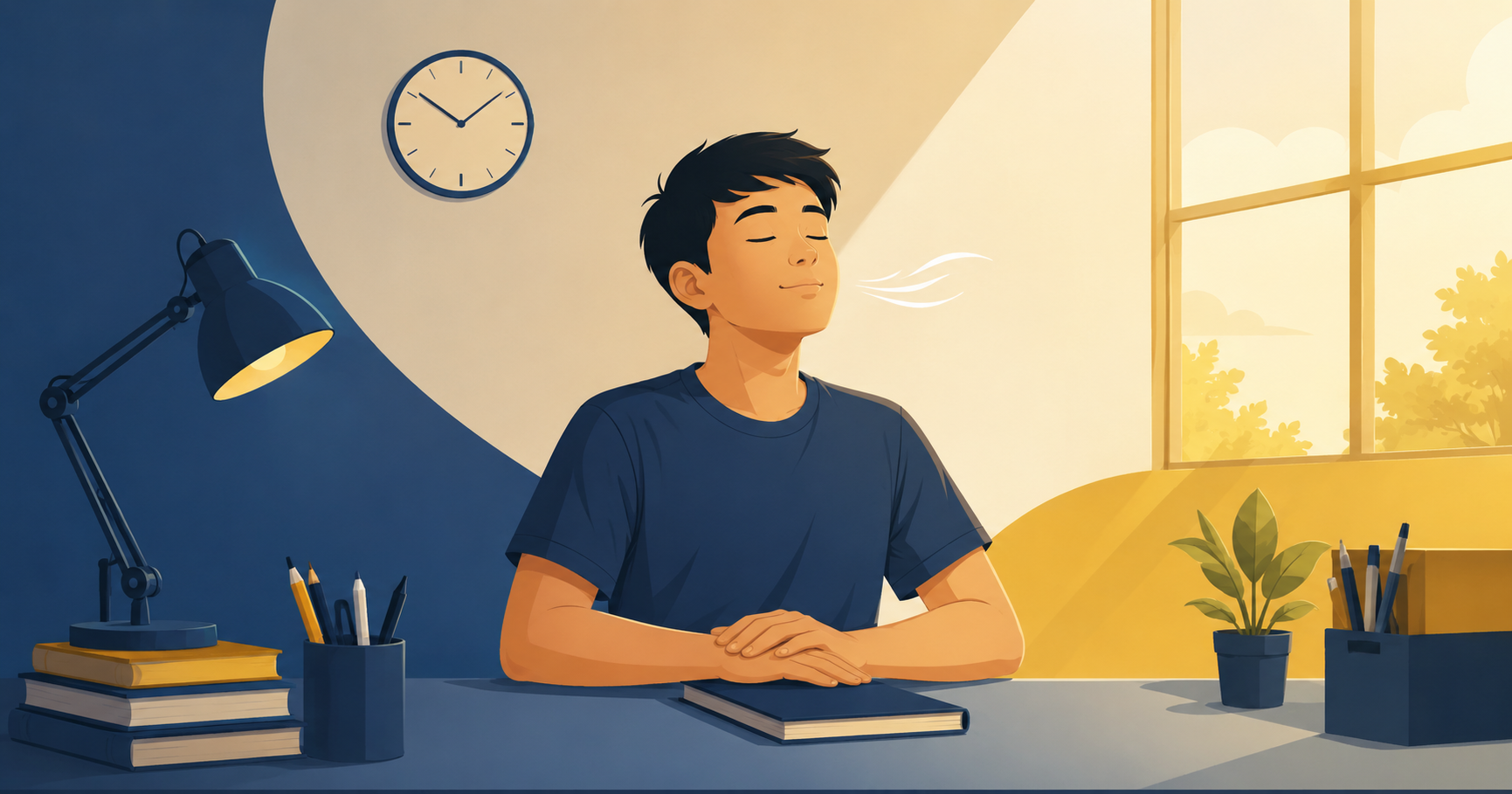
The two-minute settle. When the exam starts, resist the urge to immediately attack question one. Take thirty seconds: breathe in slowly for four counts, hold for four, exhale for four. Do this two or three times. It sounds trivial, but slow exhaling directly signals your nervous system to calm down, and thirty seconds spent settling saves minutes of scattered reading later.
Start with your strength. Within whatever the exam rules allow, begin with the section or question types you're most confident in. Early correct answers build momentum, and momentum is the antidote to panic.
Skip and return. Anxiety spikes when you're stuck. Give any question a fair attempt, and if it's not clicking, mark it and move on. Coming back later with a calmer mind — and with your brain having worked on it in the background — often makes stuck questions suddenly readable. Never let one hard item burn ten minutes and your composure.
When your mind goes blank, ground yourself. If panic hits mid-exam — heart racing, words swimming — put your pencil down for twenty seconds. Feel your feet on the floor, take three slow breaths, and read the next question out loud in your head, word by word. Blanking is temporary; it passes fastest when you stop fighting it and briefly reset.
Ignore everyone else. Someone will finish early and walk out looking confident. This means nothing. Fast finishers are just as often guessers as geniuses. Your only competition is the 80% passing threshold, not the person beside you.
Reframe what a "fail" means
Part of what makes these exams frightening is treating them as one-shot, all-or-nothing events. They aren't. There's no limit on CSE attempts — the exam is held roughly twice a year, and each attempt is independent. Failing once costs you a filing fee and a few months, not your future. Genuinely internalizing that this is a retakeable exam lowers the stakes in your mind, and lower perceived stakes means lower anxiety — which, ironically, makes you more likely to pass the first time.
A simple pre-exam week plan
Seven days out, shift from learning new material to reviewing and practicing. Days seven to three: one practice quiz per day per weak section, plus light review of notes. Day two: one final timed mock exam in the morning, then stop. Day one (the eve): no studying — prepare your kit, eat well, sleep early. Exam day: wake early, normal breakfast, arrive with time to spare, and use the two-minute settle before you begin.
Nerves will still show up on exam day. That's fine. The goal was never to feel zero anxiety — it's to be so familiar with the exam's format, timing, and question styles that anxiety has nothing left to feed on.
This guide offers general study and wellness tips, not medical advice. If anxiety significantly affects your daily life beyond exams, consider talking to a healthcare professional. Pasa is an independent study aid and is not affiliated with the CSC or AFP.