AFPSAT 30-Day Study Plan: A Week-by-Week Reviewer Schedule
By GMBOY · Published 10/15/2026 · Updated 10/15/2026 · 6 min read
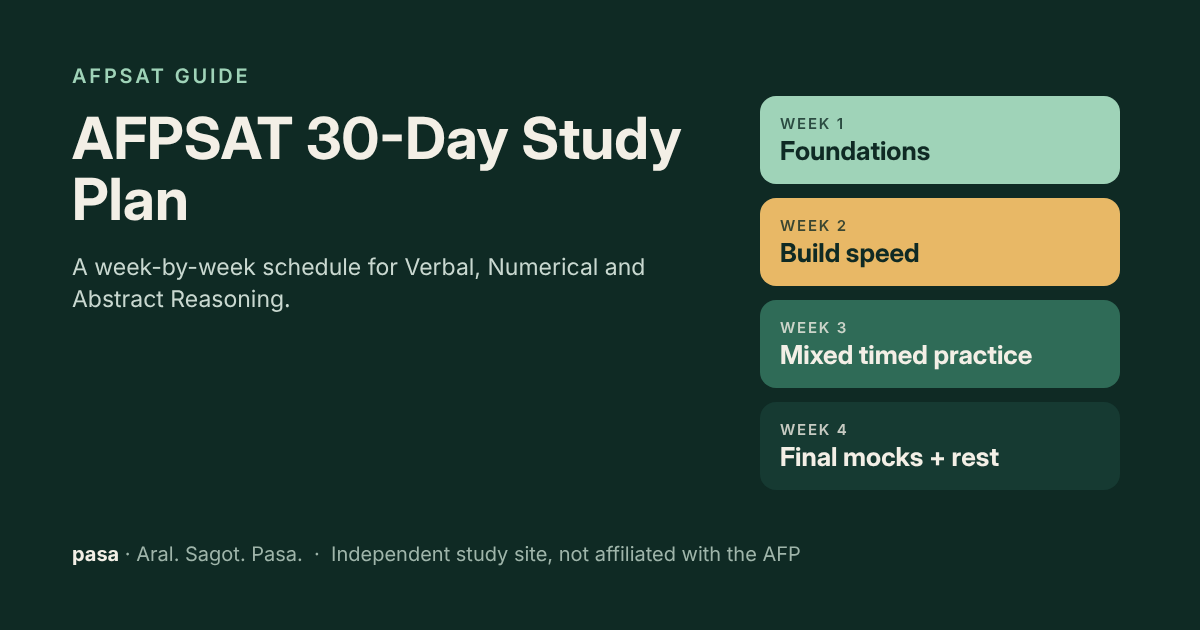
Thirty days is enough time to make a real difference in your AFPSAT preparation, as long as the time is used with a plan. This guide breaks the month into four weeks, each with one clear goal. It works with 60–90 minutes a day, and there is a lighter version at the end if you are working or studying full time.
The plan follows the three sections in the format Pasa models: Verbal Reasoning (65 items, 35 minutes), Numerical Reasoning (35 items, 35 minutes) and Abstract Reasoning (50 items, 12 minutes). Always follow the instructions given by your examiners on test day.
Before you start: take a baseline
On Day 1, take one full timed mock exam before studying anything. Don't worry about the score. You are collecting three pieces of information:
- Your weakest section. This gets the most time in Week 1 and Week 2.
- Your pacing problem. Did you run out of time, or finish early and make careless mistakes?
- Your mistake types. Did you miss items because you didn't know the concept, misread the question, or rushed?
Write these three things down. You will compare them with your final mock on Day 29.
Week 1 (Days 1–7): Foundations
Goal: Understand every question type before worrying about speed.
| Day | Main focus (45–60 min) | Short review (15 min) |
|---|---|---|
| 1 | Baseline mock exam | Write down your three findings |
| 2 | Verbal: vocabulary and analogies | Start a vocabulary list of 10 words |
| 3 | Numerical: fractions, percentages, ratios | Redo any item you missed |
| 4 | Abstract: rotation, counting and shading patterns | Review 10 vocabulary words |
| 5 | Verbal: reading comprehension | Redo missed numerical items |
| 6 | Numerical: number series | Add 10 new vocabulary words |
| 7 | Rest or light review only | Read your mistake notes once |
Practise untimed this week. Read every explanation, including the ones you answered correctly, because a correct guess can hide a gap.
Useful reading for Week 1:
Week 2 (Days 8–14): Build speed
Goal: Reach the target pace for each section in short sets.
The average time per item in the format Pasa models is about 32 seconds for Verbal, 60 seconds for Numerical and 14 seconds for Abstract Reasoning. This week, practise in short timed sets at that pace.
| Day | Main focus | Timed set |
|---|---|---|
| 8 | Verbal | 20 items in about 11 minutes |
| 9 | Numerical: word problems | 10 items in about 10 minutes |
| 10 | Abstract | 20 items in about 5 minutes |
| 11 | Your weakest section | Two short timed sets |
| 12 | Numerical: estimation and elimination | 10 items in about 10 minutes |
| 13 | Verbal and Abstract | One set each |
| 14 | Rest or light review | Review your mistake log |
If your accuracy drops sharply when you add the timer, slow down slightly for a few days, then try again. Speed built on guesswork doesn't last.
Week 3 (Days 15–21): Mixed timed practice
Goal: Switch between question types and sections without losing focus.
- Days 15, 17, 19: Do one full section under exam time. Rotate Verbal, Numerical and Abstract.
- Days 16, 18, 20: Spend the whole session on review. Sort every mistake into a type (concept, misread, calculation, time). Our guide on reviewing your mock exam mistakes explains this method step by step.
- Day 21: Take a second full mock exam.
Compare your Day 21 mock with Day 1. Look at pacing and mistake types, not only the total score.
Week 4 (Days 22–30): Final mocks and taper
Goal: Make the full test feel familiar, then rest.
| Day | Plan |
|---|---|
| 22–24 | Targeted practice on the two question types you still miss most |
| 25 | Full mock exam |
| 26 | Review the mock carefully |
| 27 | Short mixed sets, then stop early |
| 28 | Confirm venue, travel, and what to bring. Read the exam day guide |
| 29 | Final mock exam, compared with Day 1 |
| 30 | Light review of your mistake log only. Rest. |
Do not learn new topics in the final two days. Reviewing what you already know keeps your confidence up. If nerves are building, return to a short, familiar review routine and focus on the next question or task.
Lighter version for working applicants
If you only have 30 minutes on weekdays, keep the same four-week goals but shrink each day:
- Weekdays: 20 minutes of practice and 10 minutes of review, one section per day.
- Saturdays: One full section under exam time.
- Sundays: Rest, or a single 15-minute review of your mistake log.
- Mocks: Take full mocks on the Saturdays of Week 1, Week 3 and Week 4.
Consistency matters more than long sessions. Thirty focused minutes every day usually beats one long weekend cram.
Common mistakes with study plans
- Only practising your favourite section. It feels productive, but the weakest section usually has the most points to gain.
- Doing questions without reviewing. The review is where most of the learning happens.
- Starting timed practice too early. Learn the patterns first, then add speed.
- Skipping rest days. Rest helps you remember what you studied and keeps you from burning out before the exam.
Frequently asked questions
Is 30 days enough to prepare for the AFPSAT?
For many learners, yes, if they study consistently and review their mistakes. If you are starting with weak fundamentals, begin earlier or extend Week 1.
How many hours a day should I study?
About 60–90 minutes is enough for this plan. If you have less time, use the lighter version above.
Should I study all three sections every day?
Not necessarily. Rotating one or two sections per day lets you focus more deeply. Full mocks keep all three sections fresh.
Are Pasa's mock exams the same as the official AFPSAT?
No. Pasa's questions and mock exams are original study material. They model the test format for practice and do not reproduce an official AFPSAT examination.
Pasa is an independent study site and is not affiliated with, endorsed by, or operated by the Armed Forces of the Philippines. For official requirements and schedules, check the official AFP and service-branch recruitment channels.
Official-information reminder
Pasa is an independent study site. It is not affiliated with, endorsed by, or operated by the Armed Forces of the Philippines, and it does not accept applications. Practice material is original and is not an official, leaked, or recalled examination. For current requirements, schedules, and application instructions, use the Armed Forces of the Philippines, Philippine Army, Philippine Navy recruitment portal, or AFP Reserve Command.