AFPSAT Elimination and Smart Guessing Strategies for Multiple-Choice Items
By GMBOY · Published 10/15/2026 · Updated 10/15/2026 · 5 min read
On a timed multiple-choice test, you don't always need to find the right answer directly. Often it is faster to find the wrong answers and remove them. Every choice you eliminate makes your final decision easier and your guess, if you need one, more likely to be correct.
This guide covers elimination methods for each section of the format Pasa models. All examples are original study material written for Pasa, not official AFPSAT questions.
Before you guess: follow the instructions your examiners give on test day about how answers are marked and whether guessing is penalized.
Why elimination works
With four choices, a blind guess has a 25% chance. Remove one wrong choice and it rises to about 33%. Remove two and it becomes 50%. Elimination turns a hard item into a manageable one, and it often leads you straight to the answer.
Numerical Reasoning
Estimate first
Round the numbers and compare your rough answer with the choices.
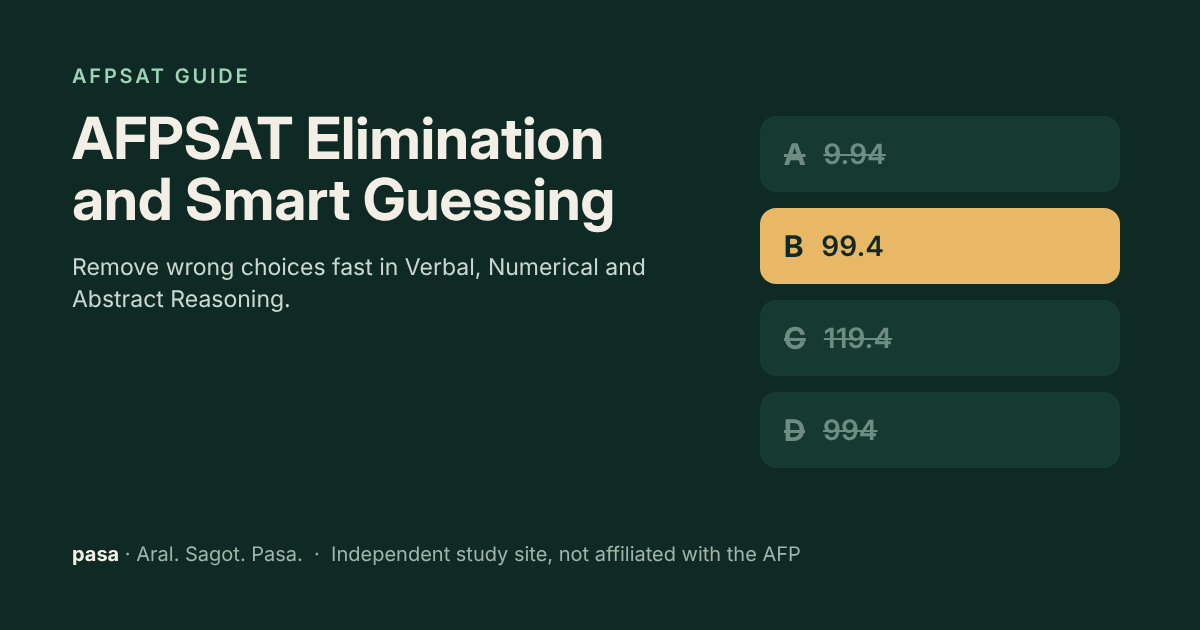
Example: What is 19.8% of 502?
(a) 9.94 (b) 99.4 (c) 119.4 (d) 994
19.8% is about 20%, and 20% of 500 is 100. Only (b) 99.4 is close. The exact answer is 99.396, but you didn't need it.
Check the last digit
The last digit of a product depends only on the last digits of the numbers being multiplied.
Example: 37 × 43 = ?
(a) 1584 (b) 1591 (c) 1596 (d) 1603
7 × 3 = 21, so the answer must end in 1. Only (b) 1591 does.
Check even or odd
An even number times any whole number is even. An odd number plus an odd number is even. These quick checks can remove choices in seconds.
Back-solve from the choices
When a problem describes a number, test the choices instead of building an equation. Start with a middle value.
Example: A number increased by 40% equals 84. What is the number?
(a) 50 (b) 56 (c) 60 (d) 64
Test (c): 60 × 1.4 = 84. Answer: (c).
Use common sense
If two workers together take longer than either one alone, or a discounted price is higher than the original, that choice is wrong. See more examples in AFPSAT Word Problems.
Verbal Reasoning
Synonyms and antonyms: check the direction
Decide whether the word is positive or negative. In a synonym item, remove choices with the opposite feeling. In an antonym item, remove choices with the same feeling.
Example: The opposite of HOSTILE is:
(a) aggressive (b) friendly (c) angry (d) unfriendly
Hostile is negative. Choices (a), (c) and (d) are also negative, so they can't be opposites. Answer: (b).
Reading comprehension: check the scope
Wrong choices in comprehension items often:
- Go beyond the passage. They say something that may be true in real life but isn't stated in the text.
- Use extreme words. Words like always, never, all and only are risky unless the passage uses them too.
- Twist a detail. They repeat words from the passage but change the meaning.
Point to the sentence in the passage that supports your answer. If you can't, be suspicious of that choice.
Analogies: name the relationship
State the relationship in a short sentence before looking at the choices. "A pilot flies a plane" fits "a driver drives a car" but not "a passenger rides a bus," because the passenger doesn't operate it. More on this in the Verbal Reasoning guide.
Abstract Reasoning
Abstract Reasoning moves fast, about 14 seconds per item in the format Pasa models, so elimination is especially useful here.
Test one rule at a time
Look at one feature across the series, such as rotation. Remove any choice that breaks that rule. Then check the next feature, such as the number of shapes or which part is shaded. Usually two rules are enough to leave one choice.
Order to check:
- Rotation or direction
- Number of shapes, lines or dots
- Shading or colour
- Size or position
See worked figures in AFPSAT Abstract Reasoning Practice.
When to guess and move on
- Set a limit. If you've spent about twice the average time on an item and still don't see the answer, eliminate what you can, choose, and move on.
- Don't leave it to chance at the end. Make your best choice the first time rather than planning to return, because you may not have time.
- Don't change answers without a reason. Change an answer only if you find a clear error, not because of a feeling.
Practice next
Try elimination on timed sets: Verbal, Numerical and Abstract practice.
Frequently asked questions
Is guessing allowed on the AFPSAT?
Follow the instructions your examiners give on test day about how answers are scored.
Should I eliminate choices on every item?
Only when the answer isn't obvious. If you know the answer, choose it and move on to save time.
Are these official AFPSAT questions?
No. All examples are original study material written for Pasa.
Pasa is an independent study site and is not affiliated with, endorsed by, or operated by the Armed Forces of the Philippines.
Official-information reminder
Pasa is an independent study site. It is not affiliated with, endorsed by, or operated by the Armed Forces of the Philippines, and it does not accept applications. Practice material is original and is not an official, leaked, or recalled examination. For current requirements, schedules, and application instructions, use the Armed Forces of the Philippines, Philippine Army, Philippine Navy recruitment portal, or AFP Reserve Command.